Soil Texture Triangle Worksheet
Twelve practice soils, a blank USDA triangle and an answer key, ready to print. Generate a fresh set any time.
Download a blank triangle (SVG) to plot the points by hand.
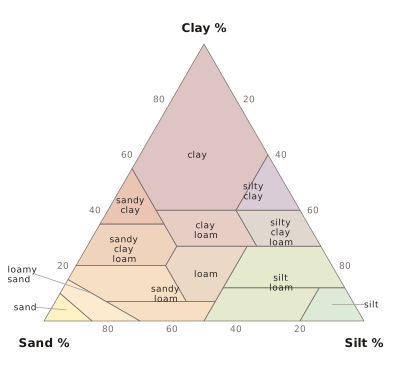
Soil Texture Triangle Worksheet
Name: ______________________________ Date: ______________
Instructions
- For each soil, plot sand, silt and clay on the triangle. Need a refresher? How to read the triangle.
- Where a soil gives only sand and clay, work out silt first: silt = 100 − sand − clay[1].
- Write the texture class on the blank line. Check your work against the answer key.
Problems
Every soil sits inside one of the 12 USDA texture classes[1].
- Soil 1Sand 57% · Silt 5% · Clay 38%Class:
- Soil 2Sand 85% · Clay 12% · Silt %Class:
- Soil 3Sand 12% · Clay 32% · Silt %Class:
- Soil 4Sand 92% · Silt 3% · Clay 5%Class:
- Soil 5Sand 69% · Silt 7% · Clay 24%Class:
- Soil 6Sand 14% · Clay 17% · Silt %Class:
- Soil 7Sand 44% · Silt 46% · Clay 10%Class:
- Soil 8Sand 37% · Silt 4% · Clay 59%Class:
- Soil 9Sand 1% · Silt 45% · Clay 54%Class:
- Soil 10Sand 54% · Clay 1% · Silt %Class:
- Soil 11Sand 2% · Silt 91% · Clay 7%Class:
- Soil 12Sand 40% · Silt 28% · Clay 32%Class:
Plot your answers
Answer key
Each answer is the class the Soil Survey Manual’s rules give for that soil[1].
- Soil 1.Sand 57% · Silt 5% · Clay 38%→Sandy clay
- Soil 2.Sand 85% · Silt 3% · Clay 12%→Loamy sand
- Soil 3.Sand 12% · Silt 56% · Clay 32%→Silty clay loam
- Soil 4.Sand 92% · Silt 3% · Clay 5%→Sand
- Soil 5.Sand 69% · Silt 7% · Clay 24%→Sandy clay loam
- Soil 6.Sand 14% · Silt 69% · Clay 17%→Silt loam
- Soil 7.Sand 44% · Silt 46% · Clay 10%→Loam
- Soil 8.Sand 37% · Silt 4% · Clay 59%→Clay
- Soil 9.Sand 1% · Silt 45% · Clay 54%→Silty clay
- Soil 10.Sand 54% · Silt 45% · Clay 1%→Sandy loam
- Soil 11.Sand 2% · Silt 91% · Clay 7%→Silt
- Soil 12.Sand 40% · Silt 28% · Clay 32%→Clay loam
Worked solution: Soil 2
Soil 2 gives 85% sand and 12% clay. Silt is 100 − 85 − 12 = 3%, because the three always total 100. Follow 12% clay straight across from the left edge and 85% sand up and to the left from the bottom edge; the 3% silt line from the right edge meets them at the same point, inside loamy sand[1].
How the problems are made
- Each set comes from a seed in the page address, so the same link always prints the same twelve soils, and New worksheet draws a fresh seed.
- Every soil sits at least 2 points inside its class, away from any boundary, so no answer depends on which side of a line a point falls[1].
- Four soils give only sand and clay, so students work out silt first.
- The answers come from the same class rules as the texture triangle calculator, and our tests check those rules against the triangle drawing at every 1% step.
Take it further: test a real soil
Once students can read the chart, give them a real sample. A jar test separates soil into sand, silt and clay layers that settle over a few days, and dividing each layer by the total gives the three percentages[2]. The ribbon test estimates the class by feel in class time, and a soil lab’s particle-size test reports the exact percentages with the USDA class[3]. Plot the jar result and the ribbon result on the same triangle and compare.
For background on the three particles, see sand, silt and clay, and for what each class means, our guide to soil types.
Frequently asked questions
- Is this worksheet free to use in class?
- Yes. Print it and share it with students freely.
- How are the answers checked?
- With the USDA Soil Survey Manual’s texture-class rules[1], the same rules our texture triangle tool uses.
- Can I make a different worksheet?
- Press New worksheet for a fresh set. The page address changes, so you can share that exact set.
- Can I save it as a PDF?
- Press Print worksheet and choose Save as PDF in your browser's print dialog. You get the same three sheets: problems, a blank triangle and the answer key.
- Why do some soils leave out silt?
- So students practice the step every reading starts with: sand, silt and clay always total 100%, so any two give the third[1].
Sources
- USDA NRCS, Soil Survey Manual (Agriculture Handbook 18), Ch. 3 “Examination and Description of Soil Profiles” (Soil Science Division Staff; eds. Ditzler, Scheffe, Monger; 2017)
- Colorado State University Extension, Estimating Soil Texture (GardenNotes #214)
- Penn State Agricultural Analytical Services Laboratory, Particle Size and Sand Sieve Test
Marko Visic · MPharm, BSc Physics · Last reviewed November 13, 2026